

We’ve all been there. Staring at a familiar, frustrating pattern in our lives, wondering if we’re doomed to repeat it forever. We ask ourselves the big, scary question: “Can people really change?”
But maybe that’s the wrong question. It’s a yes-or-no question that invites a simple, often hopeless, answer. A more useful, more empowering question is: “How can people change?”
The answer, it turns out, is less about a single, monumental transformation and more about a quiet, consistent process of awareness and small adjustments.
Progress, Not Perfection
In the show Ted Lasso, the ever-grumpy Roy Kent asks the wise Higgins if people can change. Higgins’s response is a masterclass in realistic self-improvement:
“Human beings are never going to be perfect, Roy. The best we can do is to keep asking for help and accepting it when you can. And if you keep doing that, you’ll always be moving toward better.”
This is the foundation. The goal isn’t to become a flawless new person overnight. The goal is simply to be “moving toward better.” It’s a continuous journey, not a destination. And a crucial part of that journey involves accepting that we can’t do it alone. But where does the personal work start? It starts with looking inward.
You’ve Already Broken the Cycle
We often find ourselves repeating behaviors we learned long ago. As I learned from a recent podcast on parenting, our brains are wired to seek out what’s familiar, what feels like “home” – even if home wasn’t a healthy environment. Our nervous system craves that familiar pattern, and it takes conscious effort to choose a different path.
That’s why many of us stay in uncomfortable situations (job, relationship, etc.), and at the same time fear repeating mistakes or passing down generational trauma.
But here is the single most powerful truth from that discussion: The very fact that you are reflecting on a pattern means you have already broken the cycle.
Awareness is change. Once you see a pattern, you can’t completely unsee it. You may not be able to shift everything overnight, but even small tweaks can interrupt the cycle. Think about that. The cycle thrives in ignorance. It operates on autopilot. The moment you become aware of it – the moment you pause and think, “I don’t want to do that anymore” – you’ve introduced a break in the chain. Awareness is the first and most important step.
The Power of a Tiny Tweak
Once you’re aware of a pattern, you can’t un-see it, and your behavior will inevitably begin to shift. Change doesn’t require a heroic leap. It’s about the small stuff.
It’s pausing for two seconds before reacting. It’s choosing a different phrase. It’s noticing the old feeling and deciding not to act on it just this once. These aren’t failures if you don’t do them perfectly every time. Each small, intentional action is a “tweak.” It’s a tiny course correction that, over time, leads you to a completely different place.
Change begins with recognizing the pattern, and it is achieved through small, consistent steps. It’s a process of awareness followed by tiny, intentional actions.
Try one of these today:
- Take one mindful breath before you reply.
- Name the pattern out loud (“I’m about to people-please”).
- Ask for help from one trusted person.
- Choose a micro-boundary (end one conversation five minutes earlier).
- Write one sentence about what you noticed.
So yes, people can change. We change by noticing. We change by asking for help and accepting it. We change by reflecting on our past and daring to imagine a different future. And most importantly, we change one small step at a time.
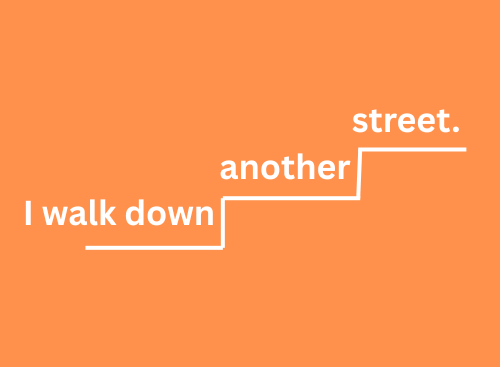
This entire journey – from mindless repetition to eventual freedom – is perfectly captured in Portia Nelson’s famous poem. It reminds us that change begins with awareness, and with each step, it is what finally allows us to choose a different street.
Autobiography in Five Short Chapters
by Portia Nelson, from There’s a Hole in My Sidewalk: The Romance of Self-Discovery (1993)
Chapter One
I walk down the street.
There is a deep hole in the sidewalk.
I fall in.
I am lost … I am helpless.
It isn’t my fault.
It takes forever to find a way out.
Chapter Two
I walk down the same street.
There is a deep hole in the sidewalk.
I pretend I don’t see it.
I fall in again.
I can’t believe I am in this same place.
But, it isn’t my fault.
It still takes a long time to get out.
Chapter Three
I walk down the same street.
There is a deep hole in the sidewalk.
I see it is there.
I still fall in … it’s a habit … but,
My eyes are open.
I know where I am.
It is my fault.
I get out immediately.
Chapter Four
I walk down the same street.
There is a deep hole in the sidewalk.
I walk around it.
Chapter Five
I walk down another street.